

Marriage holds an important place in Vedic astrology because astrologers connect several houses, planets, signs, and divisional charts with relationships. When a first marriage ends through separation, divorce, or other circumstances, people often ask one important question: which house represents a second marriage in astrology?
The short answer is that astrologers do not follow one universal rule. Many Vedic astrologers consider the 9th house an important indicator of a second marriage, while other traditions focus primarily on the 2nd house. The 7th, 8th, 11th houses and the Navamsa chart can also play supporting roles.
Because of these different approaches, an astrologer usually studies the complete birth chart instead of making a prediction from one house alone.
Which House Represents Second Marriage in Astrology?
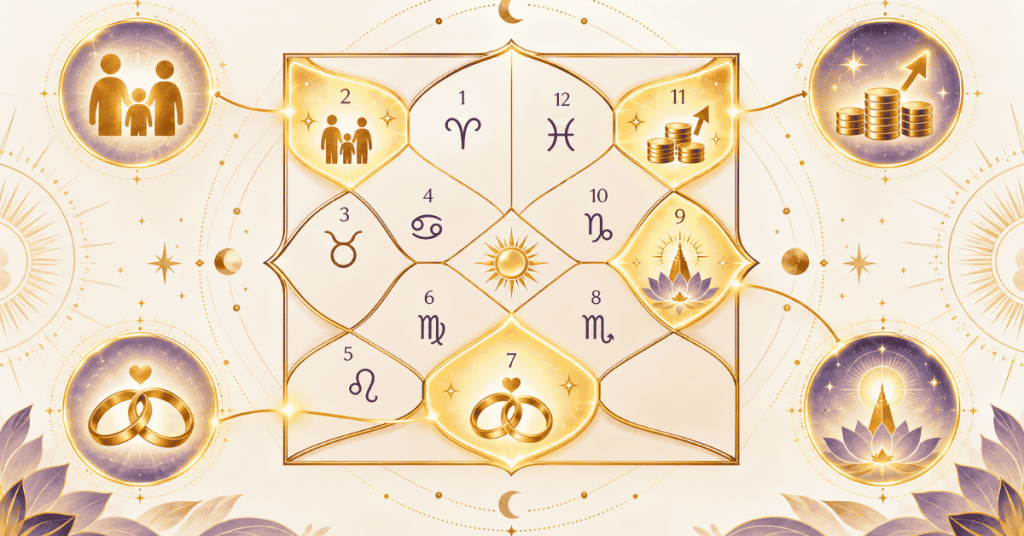
In many schools of Vedic astrology, the 9th house represents the second marriage or second spouse. The 7th house remains the main house of marriage and partnership, while the 9th house may become especially important when astrologers examine the possibility of remarriage.
However, another established approach uses the 2nd house for the second marriage because it represents family formation and can be derived from the original marriage house. KP astrology also gives considerable importance to the 2nd house while examining the 7th and 11th houses together.
Therefore, a more accurate answer is:
The 9th house is commonly studied for second marriage, but the 2nd, 7th and 11th houses should also be examined before reaching an astrological conclusion.
This broader approach produces a more complete interpretation than looking at the 9th house alone.
Why Do Astrologers Disagree About the Second Marriage House?
Astrology contains several traditions, calculation methods, and interpretive systems. As a result, astrologers may use different houses when studying remarriage.
Some Vedic astrologers treat the 9th house as the main house of the second spouse. Others use a sequence in which the 7th house represents the first marriage, the 2nd house represents the second, and the 9th house represents a later union.
Another approach considers the 11th house important because it represents fulfillment, gains, and the realization of desires after relationship changes.
Current astrology sources reflect this disagreement. Some explicitly identify the 9th house as the primary second-marriage house, while others describe the 2nd house as the main house to examine.
For this reason, experienced astrologers rarely make remarriage predictions from a single placement.
The Role of the 7th House in Second Marriage Astrology
The 7th house is the foundation of marriage astrology.
It traditionally represents marriage, spouse, committed partnerships, contracts, and one-to-one relationships. Even when an astrologer studies a second marriage, the condition of the 7th house still matters.
For example, an astrologer may examine the sign occupying the 7th house, the placement of the 7th lord, planets placed inside the 7th house, and planetary aspects affecting it.
A strong 7th house may suggest greater capacity for partnership, while challenging placements may traditionally be interpreted as relationship difficulties. However, no single placement proves divorce or remarriage.
Astrologers normally combine several factors before making any interpretation.
Why Is the 9th House Associated With Second Marriage?
The 9th house receives significant attention in many Vedic astrology systems when astrologers examine remarriage.
Traditionally, the 9th house represents fortune, beliefs, higher learning, long journeys, teachers, dharma, and important developments in life. Some astrologers also connect it with the second spouse through derived-house techniques.
In second marriage astrology, they may examine the strength of the 9th house, its ruling planet, planets positioned there, and connections between the 7th and 9th houses.
For example, astrologers may pay attention when the lord of the 7th house connects with the lord of the 9th house through placement, conjunction, or aspect.
A strong 9th house alone does not guarantee another marriage. Instead, practitioners usually treat it as one part of a larger pattern.
What Does the 2nd House Mean for Remarriage?
The 2nd house represents family, accumulated resources, speech, values, possessions, and household continuity in traditional Vedic astrology.
This makes it relevant when someone creates a new family after a previous marriage ends.
Some astrologers go further and treat the 2nd house as the principal house of second marriage. One commonly used method places the 7th house as the first marriage and then uses derived-house calculations to identify the next marital union.
KP astrology places particular emphasis on the 2nd cusp when analyzing remarriage and studies its relationship with the 7th and 11th houses.
Therefore, someone searching for the house for second marriage in astrology should not ignore the 2nd house.
It may reveal important information about the formation and stability of a new household.
What Role Does the 11th House Play?
The 11th house traditionally represents gains, fulfillment of desires, social networks, achievements, and long-term aspirations.
In remarriage astrology, some practitioners study the 11th house because marriage represents the fulfillment of a relationship goal.
When the 2nd, 7th, 9th, and 11th houses create strong connections, astrologers may interpret the combination as more supportive of another committed partnership.
However, traditions differ considerably.
Some astrologers use the 11th house mainly as a supporting house rather than the primary house of second marriage.
The safest approach is to consider it together with the rest of the chart.
Does the 8th House Indicate Second Marriage?
The 8th house does not usually serve as the main house of second marriage, but it can still carry importance.
Traditional astrology associates the 8th house with transformation, shared resources, major life changes, hidden matters, longevity, and endings followed by renewal.
Because the 8th house sits immediately after the 7th house, astrologers may study it when evaluating changes affecting a marriage.
Some practitioners use the condition of the 8th house to understand the durability or transformation of the first marriage before examining indicators of another relationship.
An astrologer should not interpret a difficult 8th-house placement as automatic divorce.
Astrological interpretation requires context.
Importance of the Navamsa Chart for Second Marriage
The Navamsa chart, also called the D9 chart, plays a major role in Vedic marriage astrology.
Astrologers often use the birth chart, or D1 chart, to understand the broader life pattern. They then study the D9 chart to explore marriage, partnerships, planetary strength, and relationship themes in greater detail.
When analyzing a possible second marriage, an astrologer may compare the 7th house and its lord in both charts.
They may also examine Venus, Jupiter, the 9th house, and other planets connected with partnership.
A placement that appears important in the birth chart usually becomes more meaningful when similar themes appear in the Navamsa.
That process is known as chart confirmation.
Instead of relying on one placement, astrologers look for repeating patterns across multiple charts.
Which Planets Are Important for Second Marriage?
Several planets can become important during a remarriage analysis.
Venus represents love, attraction, affection, pleasure, and relationship harmony in traditional astrology. Because of these meanings, astrologers frequently examine Venus when studying marriage.
Jupiter traditionally represents wisdom, growth, prosperity, guidance, and expansion. It can also influence marriage interpretations depending on the chart and the astrological tradition being used.
Saturn may bring responsibility, maturity, delays, duties, or long-lasting commitments.
Rahu can represent unconventional experiences, strong desires, unusual circumstances, or relationships outside traditional expectations.
Mars may indicate passion, energy, conflict, courage, or intensity depending on its condition.
No planet should automatically be labeled positive or negative.
Its sign, house, dignity, aspects, conjunctions, rulership, and position in divisional charts all influence the interpretation.
Dual Signs and the Possibility of More Than One Marriage
Some Vedic astrologers also examine dual signs when studying multiple relationships.
Gemini, Virgo, Sagittarius, and Pisces traditionally fall into the dual or mutable category.
If the 7th house, 7th lord, Venus, or another important marriage indicator strongly connects with a dual sign, some practitioners may consider it one possible indication of more than one significant partnership.
However, this factor cannot predict a second marriage on its own.
Millions of people have important planets in dual signs without experiencing multiple marriages.
An astrologer needs several supporting indications before interpreting remarriage potential.
Can the 7th Lord Show a Second Marriage?
Yes, the 7th lord remains one of the most important planets in marriage analysis.
The 7th lord means the planet that rules the zodiac sign occupying the 7th house.
Astrologers study where that planet sits, which planets aspect it, which house it rules, and whether it connects with houses associated with family or remarriage.
A connection between the 7th lord and the 9th house may receive special attention in traditions that use the 9th house for second marriage.
Other practitioners may look for connections between the 7th lord and the 2nd or 11th house.
Again, one connection does not confirm remarriage.
Several factors must support the same theme.
How Do Astrologers Predict the Timing of a Second Marriage?
Finding possible remarriage indicators forms only one part of the analysis.
Timing requires another layer.
Vedic astrologers commonly use planetary periods called Dashas. The Vimshottari Dasha system remains one of the most widely used timing techniques.
An astrologer may study the Mahadasha and Antardasha of planets associated with the 2nd, 7th, 9th, or 11th houses.
They may also examine Venus, Jupiter, the 7th lord, or planets strongly connected with marriage houses.
Transits can provide another layer of interpretation.
For example, astrologers sometimes examine Jupiter and Saturn transits while studying periods that may support major relationship developments.
However, timing techniques vary significantly between astrological schools.
Can Astrology Confirm Divorce and Second Marriage?
Astrology cannot establish with certainty that a person will divorce and remarry.
Even within astrology, responsible interpretation requires multiple chart factors rather than one supposedly decisive placement.
A challenging 7th house does not automatically indicate divorce.
A strong 9th house does not automatically indicate remarriage.
A dual sign does not automatically indicate two spouses.
Human relationships depend on communication, compatibility, personal decisions, social circumstances, finances, family situations, and many other real-world factors.
Astrology should therefore function as an interpretive tradition rather than a substitute for personal judgment.
Which House Should You Check First for Second Marriage?
If you follow the Vedic approach that associates the 9th house with remarriage, you can begin with the 9th house and its lord.
However, stopping there can produce an incomplete interpretation.
A stronger reading examines the relationship between several houses.
| House | Traditional Role in Remarriage Analysis |
| 2nd House | Family formation and, in some systems, second marriage |
| 7th House | Marriage, spouse, and committed partnership |
| 8th House | Transformation and durability of marriage |
| 9th House | Second spouse in many Vedic traditions |
| 11th House | Fulfillment, gains, and relationship goals |
| Navamsa/D9 | Deeper marriage and partnership analysis |
This approach explains why different astrologers may give different answers to the question which house represents second marriage in astrology.
They may simply follow different astrological systems.
Second Marriage in Vedic Astrology: Look for Repeating Patterns
A good astrological analysis looks for repetition.
Suppose the birth chart shows a connection between the 7th and 9th houses. The Navamsa chart shows another relationship between the same planets. A favorable planetary period later activates those houses.
An astrologer may consider that pattern more meaningful than a single isolated placement.
The same rule works in the opposite direction.
If only one weak indicator appears and the rest of the chart does not support it, an astrologer should avoid making a dramatic prediction.
This approach makes the interpretation more balanced and reduces oversimplification.
Does a Second Marriage Chart Guarantee a Better Relationship?
No birth chart can guarantee the success of a marriage.
Astrologers may interpret certain placements as supportive of harmony, commitment, growth, or stability, but real relationships still require effort.
Communication matters.
Trust matters.
Financial understanding matters.
Emotional maturity matters.
Shared values matter.
A birth chart cannot replace these elements.
Someone considering remarriage should make decisions based on their real relationship, personal wellbeing, values, and circumstances rather than relying entirely on an astrological prediction.
Final Answer: Which House Represents Second Marriage in Astrology?
So, which house represents second marriage in astrology?
In many Vedic astrology traditions, the 9th house represents the second marriage or second spouse. However, several practitioners consider the 2nd house the main house of remarriage, while the 7th and 11th houses remain highly relevant.
The 7th house establishes the overall condition of marriage and partnership.
The 2nd house relates to family formation.
The 9th house becomes the second-marriage house in several Vedic systems.
The 11th house may show fulfillment of relationship goals.
The Navamsa chart helps astrologers confirm patterns seen in the main birth chart.
Therefore, you should never judge second marriage from one house alone.
A complete Vedic astrology reading examines the houses, their lords, planetary aspects, Venus, Jupiter, the Navamsa chart, Dashas, and relevant transits before forming an interpretation.
Astrology remains a traditional belief system rather than a scientifically established method for predicting marriage outcomes. Use it for reflection if it is meaningful to you, but base major relationship decisions on real circumstances, communication, and personal judgment.
Frequently Asked Questions
Which house is responsible for second marriage in astrology?
Many Vedic astrologers associate the 9th house with second marriage. Other traditions use the 2nd house, so astrologers often study both along with the 7th and 11th houses.
Does the 9th house show the second spouse?
In several Vedic astrology traditions, astrologers use the 9th house to study the second spouse and remarriage. However, this method is not universal across every astrological school.
What does the 2nd house indicate in second marriage astrology?
The 2nd house represents family, household continuity, values, and resources. Some astrologers also consider it the primary house for a second marriage.
Is the 7th house only for the first marriage?
The 7th house primarily represents marriage and committed partnerships in general. Astrologers continue to examine it even when studying remarriage.
Which chart should be checked for second marriage?
Astrologers usually examine the main birth chart together with the Navamsa or D9 chart. They may also analyze planetary periods and transits for timing.
Can Rahu in the 7th house cause a second marriage?
Some astrologers associate Rahu in the 7th house with unconventional or complicated relationship experiences. However, Rahu alone cannot confirm a second marriage.
Can Venus indicate multiple marriages?
Venus plays an important role in love and relationship astrology. Some astrologers examine Venus in dual signs or its connections with marriage houses, but no Venus placement alone confirms multiple marriages.
Can astrology predict the exact age of second marriage?
Astrologers may estimate relationship periods through Dashas and planetary transits. These techniques provide interpretations rather than scientifically reliable guarantees of an exact marriage age.
