
A T-square is one of the most recognisable aspect patterns in Western astrology, formed by an opposition and two square aspects between three planets. Astrologers traditionally associate this configuration with tension, competing priorities, and the need to find balance.
Understanding T-squares in astrology can help readers explore how astrologers interpret planetary relationships, the apex planet, and the missing leg of the pattern. These interpretations are symbolic rather than scientifically established explanations of personality or life events.
What Is a T-Square in Astrology?
A T-square in astrology is a powerful aspect pattern formed when two planets oppose each other and both square a third planet. This configuration creates a triangular shape in the birth chart, concentrating energy, pressure, and tension into one focal point. Unlike softer aspect patterns, T-squares demand action and growth, often showing where life consistently pushes you out of your comfort zone.
Astrologers generally interpret a T-square as a dynamic configuration that brings three planetary symbols into a challenging relationship. The opposition represents two contrasting positions, while the apex planet forms a square to each end of that opposition. Some practitioners connect this pattern with determination and the effort required to balance competing priorities.
However, having a T-square in a birth chart does not establish that someone will experience greater emotional conflict, stronger ambition, or faster personal development.
Definition of a T-Square Aspect Pattern
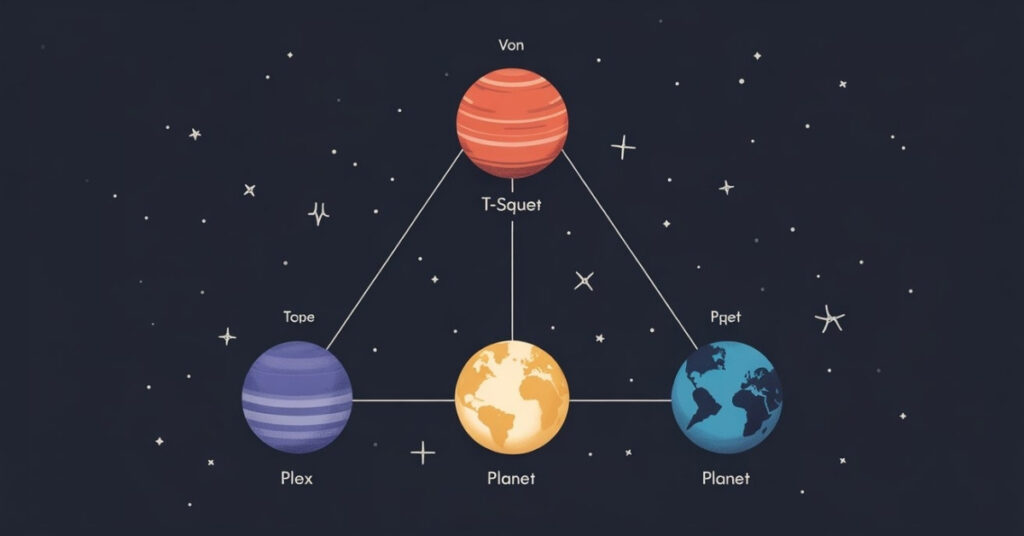
A T-square aspect pattern occurs when two planets sit in direct opposition while both form 90-degree square aspects to a third planet, known as the apex. This structure locks the planets into a dynamic struggle, keeping the energy active and unresolved until consciously worked with.
Why T-Squares Are Considered High-Tension Configurations
T-squares create pressure because the opposing planets pull in opposite directions while the apex planet absorbs and expresses that conflict. This constant push-and-pull keeps the energy in motion, often showing up as stress, urgency, or repeated life challenges.
- The opposition creates internal or external conflict
- The apex planet becomes the main outlet for tension
- The pattern generates strong motivation and drive
- Growth occurs through challenge rather than ease
How a T-Square Is Formed in a Birth Chart
A T-square forms when two planets are approximately 180 degrees apart, creating an opposition, while a third planet squares both of them. This alignment creates a triangular pattern in the chart, concentrating tension toward the apex planet. The closer the aspects, the stronger and more noticeable the influence of the T-square, often revealing areas of life where pressure, conflict, or repeated challenges occur.
In t-squares astrology, understanding formation is crucial because it explains why certain themes recur in life. By studying the placement of the planets involved, their signs, and houses, you can see where energy is concentrated and how it shapes behavior, motivation, and personal growth over time.
The Role of Two Squares and One Opposition
The opposition creates polarity between two planetary energies, while the squares increase friction and prevent easy resolution. This combination ensures that energy stays dynamic and lessons are repeated until learned.
- Opposition produces inner or external conflict
- Squares block easy solutions, keeping energy unresolved
- Forces repeated challenges that demand attention
- Encourages personal development and resilience
Planetary Geometry Behind the T-Shape
The T-shape visually highlights the apex planet, showing where tension is focused. The geometric alignment ensures that the energy does not disperse evenly, directing pressure toward one central area of life.
- Apex planet absorbs the majority of stress
- Triangle structure keeps energy active and demanding
- Visual pattern aids interpretation for astrologers
- Concentrated energy promotes growth through focus
How to Identify a T-Square in Your Birth Chart
Identifying a T-square requires more than spotting a triangular shape on a birth chart. Astrologers examine the angular distances between three planets to confirm whether they form one opposition and two squares. The actual planetary degrees matter because planets do not need to occupy perfectly exact angles for astrologers to recognise an aspect.
A birth chart calculator or aspect table can make this process easier, especially for beginners who want to understand T-squares astrology without relying entirely on visual patterns.
Step-by-Step Method to Find a T-Square
Start with a birth chart that displays planetary positions and major aspects. Then follow these steps:
- Find an opposition: Look for two planets approximately 180 degrees apart.
- Check the square aspects: Identify a third planet approximately 90 degrees from each opposing planet.
- Locate the apex: The third planet forming both squares becomes the apex.
- Check the aspect orbs: Confirm that all three relationships fall within the orb limits used by your chosen astrology method.
- Identify the missing leg: Find the zodiac position directly opposite the apex planet.
Some chart calculators identify aspect patterns automatically. Others display only individual aspects, so you may need to examine the planetary positions yourself.
Example of a T-Square With Planetary Degrees
Consider this fictional birth chart:
| Planet | Zodiac Position | Role |
|---|---|---|
| Sun | 10° Aries | First end of opposition |
| Moon | 10° Libra | Second end of opposition |
| Mars | 10° Cancer | Apex planet |
| Empty point | 10° Capricorn | Missing leg |
In this example, the Sun and Moon form an exact 180-degree opposition. Mars forms an exact 90-degree square to both, completing the T-square.
The missing leg lies at 10 degrees Capricorn, directly opposite Mars. Because all three planets occupy cardinal signs, astrologers would classify this arrangement as a cardinal T-square.
This example demonstrates the geometry only. It does not predict that an individual will experience specific emotional conflicts or life events.
What Is an Orb in T-Square Astrology?
An orb measures how far an aspect deviates from its exact angle. For example, planets separated by 93 degrees form a square with a three-degree orb because an exact square measures 90 degrees.
Astrologers use different orb limits depending on their methods, the planets involved, and whether they are evaluating individual aspects or an entire configuration. Tighter orbs generally indicate a closer geometric alignment.
A pattern recognised by one astrology program may not appear in another if the programs use different orb settings. For consistent results, check the aspect tolerances before comparing birth chart interpretations.
The Apex Planet and Why It Matters Most
The apex planet is the third planet in a T-square, forming a square aspect to both planets in opposition. Astrologers treat it as the focal point of the configuration because it connects to the other two planets through challenging aspects.
They examine its zodiac sign, house placement, and other planetary relationships to develop a symbolic interpretation of the pattern. Although the apex plays a central role in traditional readings, its position cannot reliably predict stress, behaviour, or recurring personal difficulties.
In t-squares astrology, the apex planet is both the source of stress and the potential for mastery. While the pressure it carries can feel overwhelming, consciously working with this planet allows individuals to transform tension into motivation, skill, and long-term resilience. Recognizing its role helps individuals focus on growth instead of being consumed by repeated stress.
What the Apex Planet Represents
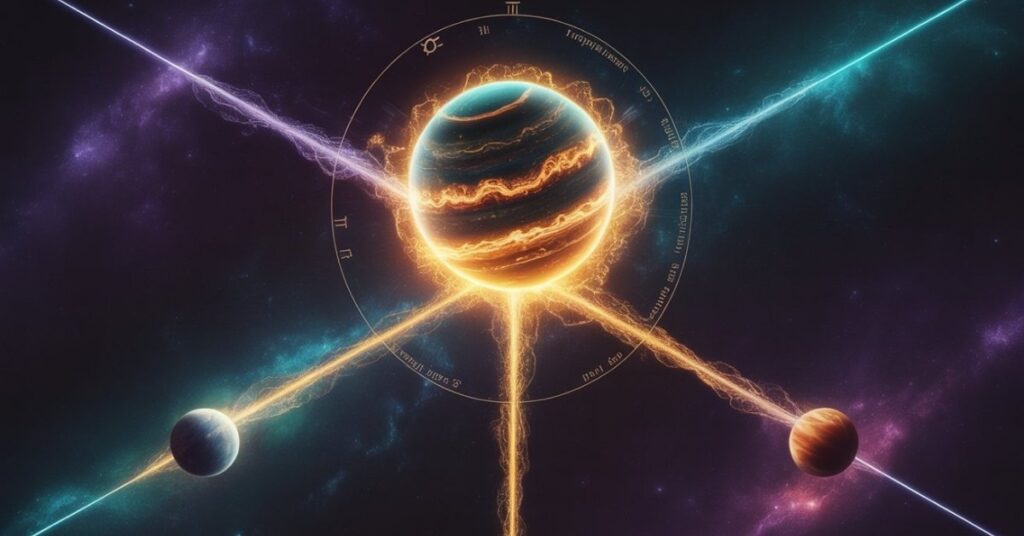
The apex planet identifies the life area where challenges are concentrated and growth is required. It serves as the main outlet for unresolved energy, highlighting recurring life themes and lessons. Understanding its influence gives insight into where personal effort will produce the most meaningful results, helping you navigate challenges more effectively.
- Directs the focus of tension toward one area
- Reveals personality strengths and weaknesses
- Shows where effort and energy produce growth
- Indicates recurring challenges and learning opportunities
How the Apex Focuses Pressure and Energy
All unresolved energy from the opposition flows into the apex planet, intensifying its influence. This concentrated pressure can feel intense but is essential for personal and emotional development. By working consciously with the apex, individuals can redirect stress into motivation, develop coping skills, and ultimately turn challenges into powerful growth opportunities.
- Amplifies focus on key life themes
- Motivates action, problem-solving, and adaptation
- Highlights where resilience and determination develop
- Provides a pathway to personal mastery
What a T-Square Means in the Natal Chart
In a natal chart, a T-square represents areas of life where tension and challenges are persistent. These patterns reveal recurring themes that push individuals toward growth, forcing adaptation and decision-making. While the pressure may feel uncomfortable, it is purposeful, guiding personal development and shaping long-term strengths.
T-squares astrology shows that life lessons often repeat until fully learned. The pattern highlights where energy is concentrated and where individuals are most likely to encounter stress, conflict, or emotional intensity. By understanding the meaning of a T-square, you can navigate challenges with awareness and use tension as a tool for growth.
Core Life Themes Created by a T-Square
T-squares point to recurring life situations that demand action, effort, and learning. These core themes often dominate key areas of personal and professional life, revealing where challenges will arise most frequently and where energy is naturally focused.
- Recurring challenges in personal and professional life
- Areas of emotional intensity and internal conflict
- Strong motivation to overcome obstacles
- Lessons that encourage personal growth and resilience
How Natal T-Squares Shape Personality
In natal astrology, practitioners sometimes interpret T-squares as symbols of persistence, internal conflict, and the challenge of balancing different priorities. They may associate particular planetary combinations with themes such as responsibility, independence, communication, or emotional expression.
However, scientific research has not demonstrated that people born with T-squares develop specific personality traits or coping abilities. Personal experiences, education, circumstances, and individual choices provide more reliable explanations of how resilience and problem-solving skills develop.
- Encourages strategic thinking and planning
- Builds confidence under pressure
- Strengthens focus and determination
- Enhances emotional and mental resilience
Psychological and Emotional Themes of a T-Square
T-squares in a natal chart often create strong psychological tension, which can manifest as restlessness, frustration, or internal conflict. This pressure acts as a catalyst, forcing individuals to confront their fears, desires, and emotional patterns. While it can feel uncomfortable, these challenges encourage self-awareness and personal growth over time.
In t-squares astrology, emotional intensity is a key feature of this pattern. People with T-squares often experience a heightened drive to achieve and a persistent need to resolve internal conflicts. By understanding these psychological dynamics, individuals can transform inner pressure into motivation and constructive action.
Inner Conflict and Emotional Stress Patterns
The opposition within a T-square creates tension between two conflicting planetary energies, while the apex planet becomes the outlet for resolving that stress. This constant internal push-and-pull generates awareness and growth when handled consciously.
- Heightened sensitivity to personal and external challenges
- Persistent inner conflict driving self-reflection
- Emotional tension that encourages problem-solving
- Motivation to confront fears and unresolved issues
Motivation, Drive, and Inner Restlessness
Restlessness caused by a T-square often fuels ambition and proactive behavior. Individuals may feel a constant need to move forward, take action, or address recurring challenges, turning pressure into productive energy rather than stagnation.
- Strong internal drive and ambition
- Constant push toward progress and achievement
- Energy channeled into problem-solving and creativity
- Restlessness motivates long-term personal growth
Cardinal, Fixed, and Mutable T-Squares Explained
T-squares can express differently depending on the modality of the planets involved: cardinal, fixed, or mutable. Cardinal T-squares push for immediate action and leadership, fixed T-squares emphasize persistence and endurance, and mutable T-squares encourage flexibility and adaptation. Understanding these differences is crucial to interpreting how tension manifests and how individuals respond to stress.
In t-squares astrology, modality reveals the style of challenge and the type of energy that the T-square generates. It provides insight into whether pressure creates impulsive action, steady perseverance, or adaptive problem-solving, helping individuals manage the pattern more effectively.
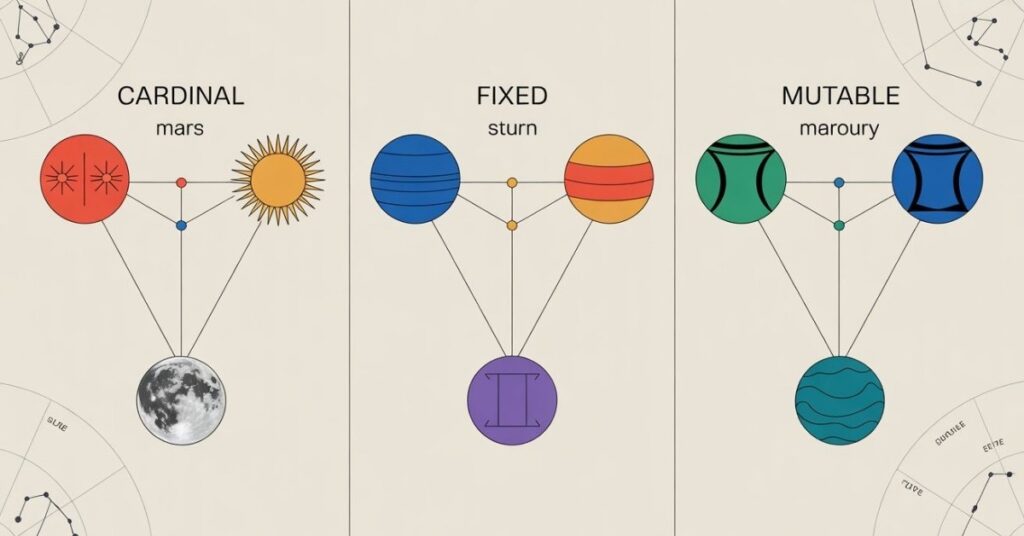
Cardinal T-Squares and Action-Oriented Pressure
Cardinal T-squares are highly dynamic, compelling individuals to take initiative and act decisively. This constant push often positions people in leadership roles, requiring quick thinking and proactive solutions to challenges.
- Promotes decisive action and leadership
- Creates fast-paced energy and urgency
- Encourages initiative in problem-solving
- Generates strong drive to achieve goals
Fixed and Mutable T-Squares Compared
Fixed T-squares generate endurance, persistence, and resistance to change, while mutable T-squares stimulate flexibility, adaptability, and mental resourcefulness. Each type presents unique challenges and strengths.
- Fixed energy builds stability and resilience
- Mutable energy allows adaptability and mental agility
- Different approaches to handling pressure and tension
- Each modality shapes personal growth pathways
How Zodiac Signs and Houses Shape a T-Square
Zodiac signs and house placements give nuance to a T-square, influencing how tension manifests and where it appears in life. Signs affect the emotional and behavioral expression of the planets, while houses indicate the areas of life most impacted by the pattern. Understanding these factors provides deeper insight into personal challenges and growth opportunities.
In t-squares astrology, knowing the signs and houses involved helps interpret how pressure operates in both personality and life events. This combination determines whether tension is expressed emotionally, mentally, socially, or materially, allowing individuals to navigate challenges more consciously.
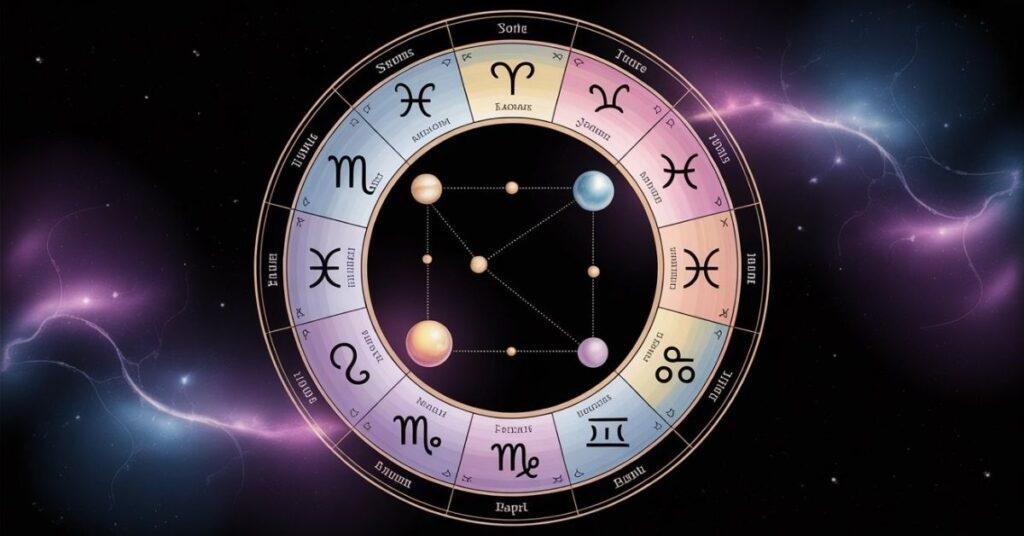
Sign-Based Expression of T-Square Energy
The signs of the planets involved determine how energy is expressed, coloring emotional responses and behavioral tendencies. Each element fire, earth, air, or water affects the intensity and style of the T-square’s influence.
- Fire signs intensify urgency, ambition, and drive
- Earth signs bring practicality, focus, and persistence
- Air signs stimulate mental tension and analytical thinking
- Water signs deepen emotional sensitivity and intuition
House Placement and Life Areas Affected
The houses in which the T-square planets are located reveal where tension and challenges appear most prominently. They indicate the arenas in life where repeated stress and growth opportunities are concentrated.
- Career, professional growth, and public roles
- Personal relationships and partnerships
- Emotional development and inner life
- Life purpose, personal identity, and long-term goals
T-Square vs Grand Cross: Key Differences
A T-square consists of three planets connected by one opposition and two squares. A Grand Cross forms when four planets occupy the four corners of a comparable configuration, creating two oppositions and four square aspects within the accepted aspect orbs.
In traditional astrological interpretation, the T-square has one primary apex, while a Grand Cross involves four interconnected positions. Astrologers may describe both patterns as challenging, but neither configuration establishes a measurable level of psychological stress or determines how difficult someone’s life will be.
In t-squares astrology, understanding the difference between these patterns helps clarify the type and degree of pressure an individual experiences. A T-square allows for focused growth and a clear outlet, whereas a Grand Cross requires more conscious management to avoid feeling overwhelmed by simultaneous challenges.
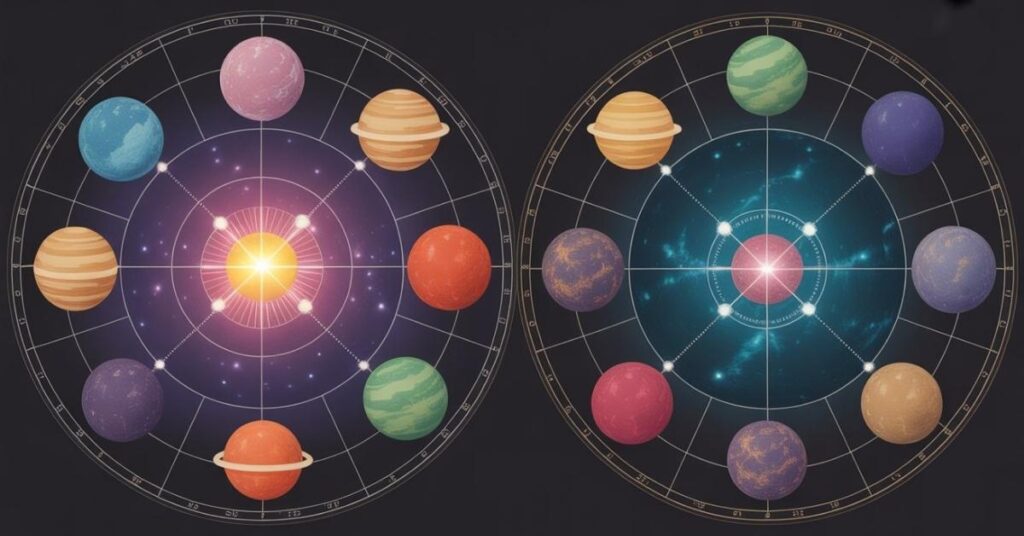
What Turns a T-Square Into a Grand Cross
Adding a fourth planet opposite the apex completes the square, forming a Grand Cross. This locks energy into continuous activation, demanding attention and resolution across multiple life areas simultaneously.
- Four points in hard aspects increase tension
- Pressure spreads across multiple life domains
- Reduces natural outlets for stress release
- Requires conscious effort to balance energy
Intensity Levels Compared Between Both Patterns
While both configurations are challenging, a T-square allows for focused direction, whereas a Grand Cross distributes pressure widely, making it feel heavier and more pervasive. Understanding these distinctions helps in managing tension effectively.
- T-squares provide focused growth and direction
- Grand Crosses create widespread, intense pressure
- Each pattern offers unique lessons and challenges
- Awareness and conscious effort are key to managing both
How T-Squares Appear in Transits and Life Events
T-square configurations can also form when planets move into the required angular relationships during their regular orbital cycles. Astrologers refer to these temporary arrangements as transit T-squares and examine their positions in relation to a birth chart. Traditional interpretations may associate these periods with competing priorities, reflection, or change.
However, there is no reliable scientific evidence that transit T-squares cause career changes, relationship difficulties, emotional distress, or other major life events.
In t-squares astrology, transit T-squares act as catalysts for growth, highlighting areas that require attention and conscious action. While they can feel intense or stressful, these periods provide opportunities for breakthroughs, personal development, and realignment with life goals.
Transit T-Squares and Temporary Challenges
Transit T-squares bring short-term periods of stress and pressure, emphasizing lessons that may have been neglected or unresolved. Awareness and proactive management help transform these challenges into growth.
- Heightened emotional and mental tension
- Short-term obstacles that demand attention
- Forces awareness of unresolved issues
- Provides opportunities for learning and adaptation
Major Life Shifts Triggered by T-Square Transits
Transit T-squares often coincide with pivotal life moments, such as career changes, relationship transitions, or personal awakenings. These events, while challenging, guide individuals toward long-term growth and transformation.
- Career advancements or changes
- Shifts in personal relationships or partnerships
- Emotional or spiritual awakenings
- Redirection toward new life goals
How to Work With a T-Square and Use Its Power
A T-square can feel challenging, but it offers enormous potential when approached consciously. Working with a T-square requires self-awareness, strategic action, and understanding the apex planet and the “missing leg” of the pattern. By engaging actively with the energy rather than resisting it, tension can be transformed into motivation, skill, and achievement.
In t-squares astrology, mastering a T-square involves identifying the areas of pressure and redirecting energy productively. When handled wisely, the T-square becomes a tool for personal growth, helping individuals develop resilience, discipline, and focused determination to reach their goals.
Finding Balance Through the Missing Leg
The missing leg is the zodiac position directly opposite the apex planet, completing the fourth corner of the geometric pattern. Some astrologers interpret this unoccupied position as a symbolic point of balance and explore its associated zodiac sign and house themes.
Other practitioners focus more closely on the three planets that actually form the T-square. The missing leg is therefore an optional interpretive concept, not a scientifically established method for reducing stress or resolving personal problems.
- Identify traits or skills to develop for stability
- Redirect energy toward constructive actions
- Reduce recurring emotional or practical tension
- Create harmony and balance in affected life areas
Turning T-Square Tension Into Growth
The pressure generated by a T-square can be transformed into motivation, achievement, and mastery. By focusing on actionable steps and personal development, individuals can harness the intensity of this pattern for long-term success.
- Channel energy into skill development and problem-solving
- Transform stress into emotional and mental resilience
- Use tension as a catalyst for personal growth
- Achieve goals with focused determination
Final thought
Understanding T-squares in astrology begins with recognising their geometric structure: one opposition, two squares, and a focal apex planet. Exploring the involved planets, zodiac signs, houses, and missing leg can help readers understand how astrologers interpret this distinctive chart pattern.
While traditional readings connect T-squares with tension and determination, the configuration cannot scientifically predict personality, emotional challenges, or future achievements. Readers can approach these interpretations as symbolic material for reflection rather than fixed descriptions of their lives.
